
Discover how franchise profit margins work and what drives financial success in franchise ownership—so you can make smarter investment decisions.
The Reality of Franchise Profitability
Before committing capital to any franchise opportunity, prospective business owners need to answer one fundamental question: "How much profit can I make?" In the featured Franchise Empire video, "How much profit can I make owning a franchise?" Marc Magerman, seasoned multi-unit franchise owner and brokerage lead at Franchise Empire, unpacks the stark differences between top-line revenue and actual bottom-line cash flow. He stresses that while franchising provides an established operating playbook, true financial success is never guaranteed—it ultimately hinges on a deep understanding of unit-level economics, operational execution, and strategic scaling. This comprehensive guide provides an analytical breakdown of those core insights, helping you evaluate financial disclosures, avoid common purchasing traps, and build a highly profitable enterprise.
The Macroeconomic Landscape of Franchising and the Profitability Inquiry
The pursuit of professional autonomy and wealth generation frequently leads corporate executives, seasoned managers, and aspiring entrepreneurs to evaluate the franchising model. Among the diverse array of initial inquiries, none is more central to the investment decision than the foundational question: "How much profit can I make owning a franchise?" In an era characterized by capital market volatility and evolving employment dynamics, the desire to transition from a corporate W-2 position to active business ownership has accelerated. However, calculating potential returns requires a detailed understanding of unit-level economics, operational variables, and systemic risk.
Historically, many individuals have entered the franchising sector under the impression that a recognized brand name and established operational systems automatically guarantee high net yields. This perspective often overlooks the operational variations that exist even within highly successful franchise networks. Total revenue capacity is not a fixed metric; rather, it represents a dynamic variable governed by geographic site selection, regional labor market conditions, localized supply chain efficiency, and the capital allocation strategies of the operator.
To build a reliable profitability projection, prospective owners must move past high-level brand marketing and focus on unit-level financial metrics. This analysis requires a careful evaluation of the Franchise Disclosure Document (FDD), secondary validation via peer-to-peer operator calls, and an understanding of the difference between top-line revenue and actual bottom-line net cash flow.
Decoding the Franchise Disclosure Document and Item 19
The primary legal and financial document in any franchise evaluation is the Franchise Disclosure Document, which contains twenty-three standardized sections regulated by the Federal Trade Commission. Within this document, Item 19 represents the section where a franchisor is permitted, though not federally mandated, to provide historical financial performance representations (FPRs) of active corporate and franchised locations. While Item 19 is a key data source for prospective buyers, interpreting these representations requires a highly critical analytical approach.
A common issue in financial analysis occurs when prospective owners mistake gross profit margins or aggregate Earnings Before Interest, Taxes, Depreciation, and Amortization (EBITDA) for the actual net profit that can be distributed to the owner. To establish a standardized model of unit economics, the following mathematical formula must be applied to fully loaded operating costs:
Net Profit Margin =

Where:
- Gross Revenue represents the total top-line sales generated by the unit before any deductions.
- COGS represents the Cost of Goods Sold, including raw materials, inventory, packaging, and waste.
- Labor encompasses hourly wages, payroll taxes, benefits, and the salaries of management personnel.
- Royalties represent the ongoing fee paid to the franchisor, typically calculated as a fixed percentage of gross sales (ranging from 4% to 8%).
- Marketing includes mandatory contributions to the national brand development fund (typically 1% to 3%) alongside required local advertising expenditures.
- Rent represents the fixed occupancy cost, including base rent, common area maintenance (CAM) charges, and property taxes.
- Admin covers professional services, commercial insurance, local licensing, technology fees, and localized administrative overhead.
Admin covers professional services, commercial insurance, local licensing, technology fees, and localized administrative overhead.
Because corporate-run locations represented in Item 19 often do not pay royalties, national marketing fees, or localized manager replacement salaries, their stated historical margins can be artificially inflated. Consequently, an investor who relies solely on these figures without adjusting for the standard cost structure of a third-party franchisee may face significant cash-flow challenges during their first year of operation.
Case Study of Operational Scaling: Marc Magerman's Five Guys Journey
A primary example of successful operational scaling is Marc Magerman, a seasoned franchise owner and currently the brokerage lead at Franchise Empire. Magerman's transition from single-unit operator to multi-unit owner illustrates how operational discipline and strategic portfolio expansion drive long-term profitability. Along with his business partner Peter Weber, Magerman co-founded 8G Hospitality Associates, LLC, subsequently developing and managing thirteen Five Guys locations across Massachusetts over a seven-year period.
This rapid expansion showcases how scaling can compound capital. In the early phases of their Five Guys development, Magerman and his team focused heavily on unit-level execution, bringing their initial location to profitability in less than 60 days. This achievement requires strict adherence to the brand's operational playbook, minimizing waste, and managing labor scheduling during peak periods.
A central element of Magerman’s real estate philosophy is that site selection directly impacts long-term profitability. In the fast-casual restaurant sector, trying to minimize overhead by choosing a lower-cost, secondary commercial location is often a costly error. Magerman highlights that high-visibility, high-traffic locations naturally generate organic customer acquisition, which reduces long-term local marketing costs. This spatial premium is summarized by Magerman's core operational thesis that "paying top dollar for space pays you".
Now leading the brokerage division at Franchise Empire, Magerman applies this operational experience to guide prospective buyers through the due diligence process. He views the relationship between a broker and a candidate as a long-term advisory partnership rather than a one-time transaction. Magerman stresses that signing a franchise agreement is merely the start of a multi-year business build:
"I hope my relationship with my candidates don't end when they sign on the dotted line because again I think it's just the beginning of the process for any really good franchisees is they should have that 'what am I in this for,'" emphasized Magerman.
Technical Innovation and Margin Preservation in Restaurant Operations
To preserve operating margins against rising labor and real estate costs, franchise owners are increasingly adopting automated technologies. Magerman and Weber demonstrated this forward-looking approach by signing a multi-unit deal to bring Jon Taffer’s innovative full-service concept, Taffer's Tavern, to the greater Boston market, starting with Arsenal Yards in Watertown, Massachusetts.
Magerman chose this site due to the strong local demographic profile and high concentration of working professionals. This strategic real estate choice was highlighted in his public remarks regarding the development:
“We had our sights set on Arsenal Yards from the beginning. We were attracted to the unique history and metamorphosis of Watertown; it is such a desirable area for young professionals and families. Now, Taffer's Tavern will become an essential part of the fabric of this vibrant community, front and center on Arsenal Street welcoming people to the neighborhood,” said Magerman.
Beyond prime real estate selection, the Taffer's Tavern model preserves operating margins through a ventless, hoodless kitchen design. Standard commercial kitchens require expensive HVAC hoods, major structural ductwork, and dedicated prep staff, which increases initial construction costs and monthly utility overhead. By partnering with Middleby Corporation for automated cooking systems and Cuisine Solutions for proprietary sous vide co-packing, Taffer's Tavern minimized on-site food preparation.
This operational shift replaces variable prep labor with a highly predictable, standardized food cost. This model allows the restaurant to run with smaller, less specialized teams, reducing the impact of kitchen staff turnover. Magerman highlighted these operational efficiencies:
“The Taffer's Tavern 'Kitchen of the Future' balances a focus on premium food, rigorous attention to cleanliness, and efficient operations. This enables us to apply our resources and energy into ensuring that our customers receive a memorable and unique dining experience. Outstanding guest service is our top priority. We expect Taffer's Tavern to attract loyal, repeat customers,” said Magerman.
This approach aligns with a broader franchising trend toward centralized food production and co-packing. As advocated by industry experts like Dan Rowe, CEO of Fransmart, utilizing off-site co-packing reduces retail footprint requirements, lowers municipal waste, and ensures product consistency across multiple locations. This model helps protect unit-level margins even during periods of food price inflation.
The Entrepreneurial Paradox: Job Ownership vs. Capital Compounding
A common challenge in the franchising industry is a lack of clarity regarding the owner's operational role. Many individuals buy a franchise hoping to build a scalable business, yet they design an operational structure where they are the primary operator. This approach often results in the owner simply purchasing a localized job rather than building a scalable corporate asset.
This distinction between self-employment and true business ownership is a key consideration for prospective buyers. While running a single location as a hands-on manager can provide a stable income, it limits growth and exposes the owner to localized operational challenges, labor shortages, and eventual burnout. Magerman advises that while owner-operator models are a viable option for some, they do not capture the full compounding potential of franchising:
"If all you want to do is buy yourself a job, that's fine too, and you can do a lot worse than buying a franchise because you know you've got that support on the back end. But I think you're just missing so much of the opportunity. " If you go in that narrow-minded," stated Magerman.
To move beyond the limitations of a single-unit footprint, successful franchise owners often plan for multi-unit development from the outset. Operating multiple locations in a defined region allows owners to centralize back-office tasks, share staff during peak hours, and gain purchasing leverage with suppliers. By stepping back from day-to-day operations and focusing on high-level strategy, an owner can shift the business from a hands-on job into a compounding financial asset.
This systematic scaling model is taught in the Franchise Buyers Academy and supported by Franchise Empire's consulting programs, created by entrepreneur Tariq Johnson. Johnson’s background serves as a practical model for this strategy. In 2015, Johnson invested $300,000 to launch his first franchise location. By focusing on strict operational standards, he brought the unit to profitability within 60 days, eventually scaling and selling multiple locations to build a larger portfolio. His experience demonstrates that success in franchising depends on treating the business as a scalable system rather than a personal job.
A common question among corporate professionals seeking to transition into business ownership is whether they can retain their primary employment while concurrently launching a franchise. This concept, widely marketed as semi-absentee franchise ownership, is highly appealing but contains significant structural risks
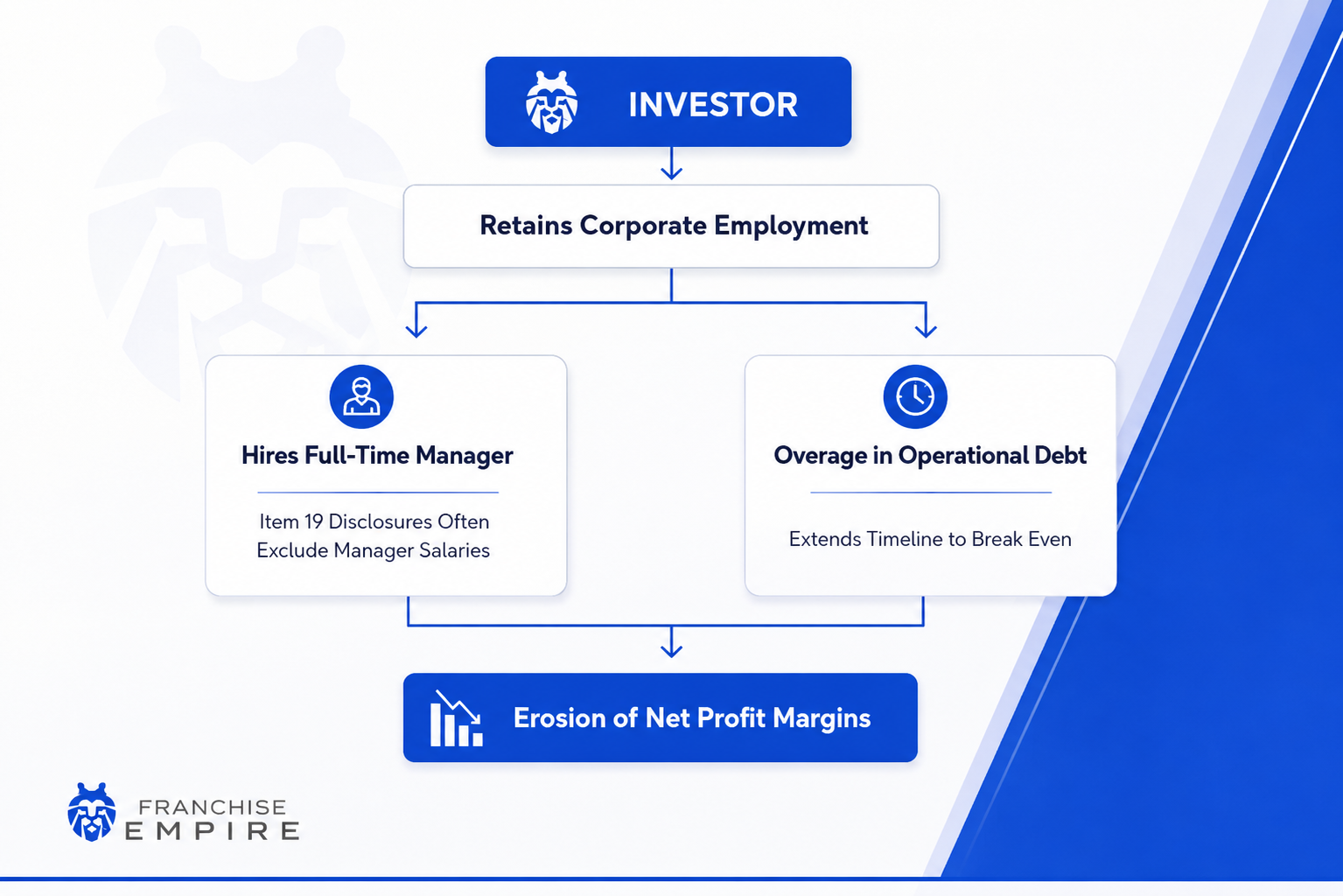
The primary operational hurdle of semi-absentee ownership is the financial cost of management labor. Many financial disclosures within Item 19 of the FDD are calculated using the performance data of owner-operated corporate locations. Because corporate-run units do not always account for the market-rate salary of a general manager in their baseline figures, prospective buyers often calculate their projected net profits using distorted numbers.
When an absentee owner hires a full-time general manager to oversee daily operations, the cost of that manager's compensation (ranging from $45,000 to over $80,000 annually depending on the sector) is deducted directly from the projected net profit margin. This immediate reduction in margin extends the timeline required for the business to break even and can push a marginal location into net operating losses.
For first-time business owners, starting with a hands-on, "all-in" approach is often highly recommended. Direct involvement during the initial stages allows the owner to master the unit-level economics, establish quality controls, and develop the operational expertise required to effectively manage supervisory staff as the portfolio scales.
Comparative Sector Economics of High-Margin Alternatives: The Home Services Frontier
While brick-and-mortar retail and food service concepts offer high top-line revenue potential, their substantial capital requirements and lower net profit margins have driven interest toward service-based and mobile franchise models. Home services, exemplified by emerging concepts like the artificial turf provider Waterloo Turf, represent a compelling alternative for capital-efficient expansion.
Waterloo Turf, led by founder Lance Ingram and VP of Operations Manny Guzman, highlights the economic advantages of service-oriented operations. Because these businesses bypass the high fixed occupancy costs of premium real estate, they can allocate capital more efficiently toward local customer acquisition and service delivery.
To understand how profit margins, capital requirements, and operational footprints differ across various industries, the following table details the key metrics of prominent franchise verticals:
|
Franchise Sector |
Typical Initial Investment Range ($) |
Average Net Profit Margin Range (%) |
Key Cost Drivers |
Operational Footprint & Complexity |
Scale Potential |
|
Quick Service Restaurants (QSR) |
$250,000 – $1,500,000+ |
10% – 15% |
Food cost (COGS), hourly labor, and premium retail leases |
High commercial footprint, complex supply chain, high staff turnover |
Moderate; dependent on commercial real estate availability |
|
Home Services (e.g., Waterloo Turf) |
$80,000 – $200,000 |
20% – 35% |
Targeted local marketing, fuel/vehicle maintenance, and skilled labor |
Low (frequently home-based or industrial flex space), mobile fleet |
High and low capital expenditures allow rapid territorial expansion |
|
Boutique Fitness & Wellness |
$150,000 – $500,000 |
15% – 25% |
Commercial lease, specialized equipment debt, certified trainers |
Medium retail footprint, membership-retention driven, high marketing CAC |
Moderate; highly sensitive to local demographic changes |
The data indicate that service-based and mobile franchise models, such as home services or artificial turf installation, often present a lower barrier to entry and higher net margin profiles than brick-and-mortar retail. Because these operations bypass the high fixed occupancy costs of premium real estate, they can allocate capital more efficiently toward local customer acquisition and service delivery. However, fast-casual food and premium retail concepts continue to offer high top-line revenue capacity and strong long-term equity value when scaled across a region.
Systematic Due Diligence and Financial Validation Protocols
To minimize risk and avoid common purchasing mistakes, prospective owners should follow a structured due diligence framework. Rather than relying solely on franchisor marketing materials, buyers should use a systematic verification process to validate the unit economics of their target brand.
The following table outlines the systematic due diligence protocol required to evaluate a franchise opportunity:
|
Phase |
Risk Vector |
Validation Action |
FDD Reference Section |
|
1. Site & Territory Validation |
Cannibalization and local market saturation |
Execute a formal territorial market check to verify exclusive territory boundaries and review local competitor density. |
Item 12 (Territory Rights) |
|
2. Financial Reality Modeling |
Overestimated net profit margins and ignored labor costs |
Build a customized local profit-and-loss (P&L) model that includes regional minimum wage rates, commercial rent estimates, and general manager salaries. |
Item 19 (Financial Performance) |
|
3. Operational Validation |
Unrealistic ramp-up timelines and hidden overhead |
Conduct 10 to 15 validation calls with active franchisees to confirm their actual time to break even and the level of support provided by the franchisor. |
Item 20 (Franchisee Registry) |
|
4. Cost & Fee Auditing |
Hidden technology, marketing, or supply chain fees |
Audit the total fee structure, including national brand funds, software fees, mandatory supplier markups, and transfer costs. |
Item 5 (Initial Fees) & Item 6 (Other Fees) |
|
5. Debt Service & Capitalization |
Insolvency from excessive leverage during the ramp-up phase |
Secure a conservative capitalization structure utilizing a mix of SBA loans, personal equity, and working capital reserves. |
Item 10 (Financing Support) |
By following this systematic verification process, prospective owners can make investment decisions based on verified market data rather than optimistic projections.
Strategic Takeaways for Aspiring Franchise Owners
The journey from "zero to profitable" requires a clear understanding of financial realities and a committed long-term vision. Rather than viewing franchising as a passive investment, successful owners treat it as an active business requiring operational focus and strong leadership. By conducting systematic due diligence, understanding unit-level margins, and building a scalable model, investors can leverage the franchisor's playbook to build a highly profitable enterprise.
Book a Consultation Call with Our Franchise Experts
Navigating the complex math of unit-level economics, validation calls, and Franchise Disclosure Documents is challenging to execute alone. If you are ready to stop "buying a job" and start building a compounding franchise empire, our elite advisory team is here to guide you.
Franchise Profitability FAQ
How much profit can I make owning a franchise?
The actual profit generated from owning a franchise varies significantly based on the industry, geographic location, operational model, and the owner’s management structure. Typically, quick-service food franchises operate on net profit margins between 10% and 15% due to high labor and inventory overhead. Conversely, mobile and service-based franchises often achieve net profit margins of 20% to 35% because they do not require expensive commercial real estate. Ultimately, profitability is determined by the operator's ability to manage unit economics and scale to multiple locations.
Why do some FDD Item 19 financial disclosures omit manager salaries?
Item 19 financial performance representations often use data from corporate-owned or owner-operated locations. Because these locations are managed directly by the owner, they do not require a market-rate general manager salary in their baseline operating costs. When an investor transitions to a semi-absentee model, they must hire a full-time manager, which adds $45,000 to $80,000 in annual labor costs and reduces the projected net profit margin.
What is the difference between "buying a job" and "building a franchise empire"?
"Buying a job" occurs when an investor purchases a single franchise unit and acts as its primary day-to-day manager. While this model can provide a stable salary, it ties the owner’s income directly to their personal labor and limits scalability. "Building a franchise empire" refers to a multi-unit strategy where the owner focuses on high-level executive management, using systems and professional managers to scale operations across multiple territories.
What did Marc Magerman mean by "paying top dollar for space pays you"?
Marc Magerman’s real estate thesis emphasizes that selecting premium, high-traffic commercial locations is often more profitable than choosing cheaper, secondary sites. High-visibility real estate naturally generates organic foot traffic, which reduces the need for expensive local marketing and helps accelerate the timeline to profitability for a new location.
How do automated kitchen systems and co-packing affect unit economics?
Automated kitchen systems and co-packing lower operating overhead by shifting labor-intensive food preparation off-site. In concepts like Taffer’s Tavern, this approach reduces kitchen footprints, eliminates the need for expensive hood systems, and standardizes food quality. These efficiencies help stabilize food and labor costs, which in turn protect unit-level margins against inflation and labor shortages.